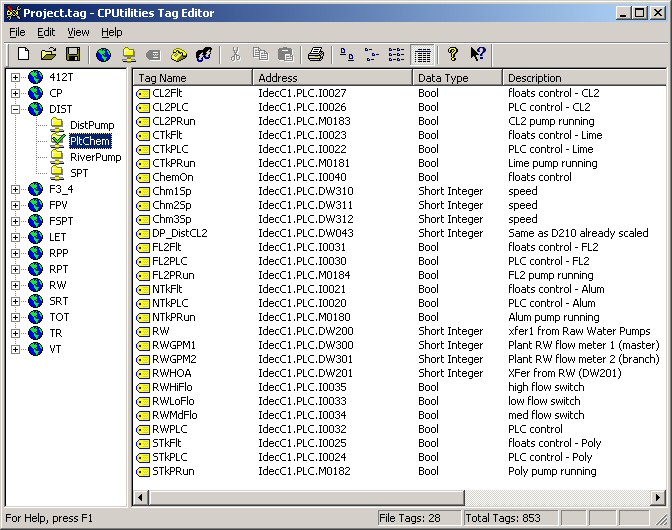
Tags are the fundamental building blocks in a CPUtilities project. Each I/O point is
identified by a 3 part tag address defining it's point of origin/location, file, and name.
This naming convention allows tags to be grouped by common functionality and easily
identified anywhere in the project. Tag assignments are made using the Tag Editor's
simplistic Window's Explorer type interface.
identified by a 3 part tag address defining it's point of origin/location, file, and name.
This naming convention allows tags to be grouped by common functionality and easily
identified anywhere in the project. Tag assignments are made using the Tag Editor's
simplistic Window's Explorer type interface.
Click Image for a Larger View
Locations contain the OPC Server, channel/data transport, and master polling interval
assignments. A location can be a physical area housing processing equipment, a
process or manufacturing line, a machine, or the actual PLC or field instrument.
Each location consists of one or more files. Files organize groups of tags and are
commonly used to categorize I/O points into process variable and setpoint types. Each
file is assigned a subordinate polling interval allowing flexible performance tuning
involving data throughput.
Tag properties include the OPC register assignment, data type, scaling, and system
security settings. Although it is common to associate all tags in a given file to a specific
PLC, this is not a requirement. It is not uncommon, for example, for a location's
setpoints to exist across field instrumentation boundaries.
assignments. A location can be a physical area housing processing equipment, a
process or manufacturing line, a machine, or the actual PLC or field instrument.
Each location consists of one or more files. Files organize groups of tags and are
commonly used to categorize I/O points into process variable and setpoint types. Each
file is assigned a subordinate polling interval allowing flexible performance tuning
involving data throughput.
Tag properties include the OPC register assignment, data type, scaling, and system
security settings. Although it is common to associate all tags in a given file to a specific
PLC, this is not a requirement. It is not uncommon, for example, for a location's
setpoints to exist across field instrumentation boundaries.

Click Image for a Larger View
Another extremely powerful feature of the Tag Editor is the configuration of Transfer
Tags. Transfer Tags identify the horizontal movement of data from a source tag to one or
more destination tags. The source and destination can exist in different files or even
different locations allowing data transfers between dissimilar PLC brands and OPC
Servers.
Each tag has an associated OPC quality identifier. If the source tag's data is not good
quality, one of five transfer actions can be taken; do nothing, send the source tag's
preset value, send the minimum value, send the maximum value, or send the last known
value. Associated logic in the destination field device can easily identify a bad data
condition and take alternative processing measures.
Tags. Transfer Tags identify the horizontal movement of data from a source tag to one or
more destination tags. The source and destination can exist in different files or even
different locations allowing data transfers between dissimilar PLC brands and OPC
Servers.
Each tag has an associated OPC quality identifier. If the source tag's data is not good
quality, one of five transfer actions can be taken; do nothing, send the source tag's
preset value, send the minimum value, send the maximum value, or send the last known
value. Associated logic in the destination field device can easily identify a bad data
condition and take alternative processing measures.

TagEdit