OPClient oversees all communications over data transport devices and OPC Servers,
and is responsible for database maintenance activities. Each installation must contain at
least one instance of OPClient running on the network, although multiple instances may
be incorporated into a single solution to distribute the overhead associated with device
communications.
and is responsible for database maintenance activities. Each installation must contain at
least one instance of OPClient running on the network, although multiple instances may
be incorporated into a single solution to distribute the overhead associated with device
communications.
Click Image for a Larger View
As information from field instrumentation and PLCs is acquired, OPClient stores the
associated tag and quality values in the RTDB. The RTDB provides the centralized data
repository allowing the suite of CPUtilities applications to share process information
locally and across IP networks.
As the defined locations are processed, OPClient is continually monitoring the status of
the associated tags in the RTDB. Any related tags that have dirty values resulting from
setpoint screen interaction or are configured as the destination of transfer tags are
written to the location's devices.
OPClient optionally supports the COM, IPersistFile interface. This feature allows the
OPC Server configuration to be dynamically loaded from a file residing on disk. OPC only
allows one brand of field device to be configured on a given channel, such as a comm
port. Telemetry systems typically have multiple types of equipment residing at remote
locations. Without the ability to change the configured driver, one channel for each
different field device brand would be necessary. In the example of using a dial-up data
transport, a separate telephone line and modem would be required for each remote type.
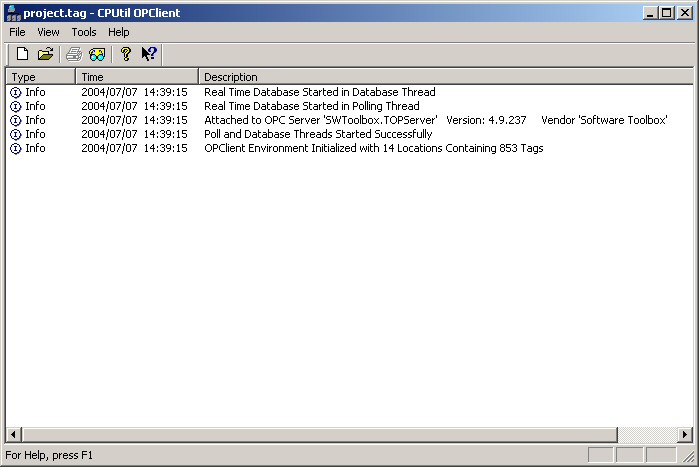
OPClient also provides diagnostic features easing the tasks of troubleshooting device
communications, database connectivity, and tag configuration issues.
associated tag and quality values in the RTDB. The RTDB provides the centralized data
repository allowing the suite of CPUtilities applications to share process information
locally and across IP networks.
As the defined locations are processed, OPClient is continually monitoring the status of
the associated tags in the RTDB. Any related tags that have dirty values resulting from
setpoint screen interaction or are configured as the destination of transfer tags are
written to the location's devices.
OPClient optionally supports the COM, IPersistFile interface. This feature allows the
OPC Server configuration to be dynamically loaded from a file residing on disk. OPC only
allows one brand of field device to be configured on a given channel, such as a comm
port. Telemetry systems typically have multiple types of equipment residing at remote
locations. Without the ability to change the configured driver, one channel for each
different field device brand would be necessary. In the example of using a dial-up data
transport, a separate telephone line and modem would be required for each remote type.
OPClient also provides diagnostic features easing the tasks of troubleshooting device
communications, database connectivity, and tag configuration issues.

OPClient